


Latest Monitoring of El Niño Condition Evolution Based on FY-3 Meteorological Satellites
An El Niño condition is identified when the 3‑month running mean of SST anomalies in the equatorial central‑eastern Pacific Niño 3.4 region (5°N–5°S, 170°W–120°W) reaches or exceeds +0.5 °C. If this condition persists for five consecutive months, an El Niño event is confirmed. Event intensity is classified by the peak anomaly of the event: 0.5–1.3 °C as weak, 1.3–2.0 °C as moderate, 2.0–2.5 °C as strong, and >2.5 °C as very strong.
Monitoring based on FY‑3 microwave‑derived SST anomalies (climatology: 1991–2020; reference: NOAA OISST v2.1) shows that the single‑month SST anomaly in the Niño 3.4 region reached +2.05 °C in July 2026 (red box, right panel of Fig. 1), continuing the rise from +1.48 °C in June 2026 (red box, left panel of Fig. 1), indicative of a strong El Niño signal. It should be noted that single‑month anomalies are not used directly for event‑intensity classification; the final event category will be assessed once the 3‑month running mean has persisted for five full months.
The FY‑satellite–derived Niño 3.4 index series (3‑month running mean) for 2011–2026 (Fig. 2) shows that:
the 2014–2016 episode (peak in the 2015/16 winter) was a very strong El Niño event;
the 2023–2024 episode was a moderate El Niño event;
most of 2025 remained ENSO‑neutral;
in early 2026, the index turned from cold to warm, crossing the +0.5 °C threshold in May, and the June 3‑month running mean rose to +1.53 °C, further consolidating the El Niño condition.
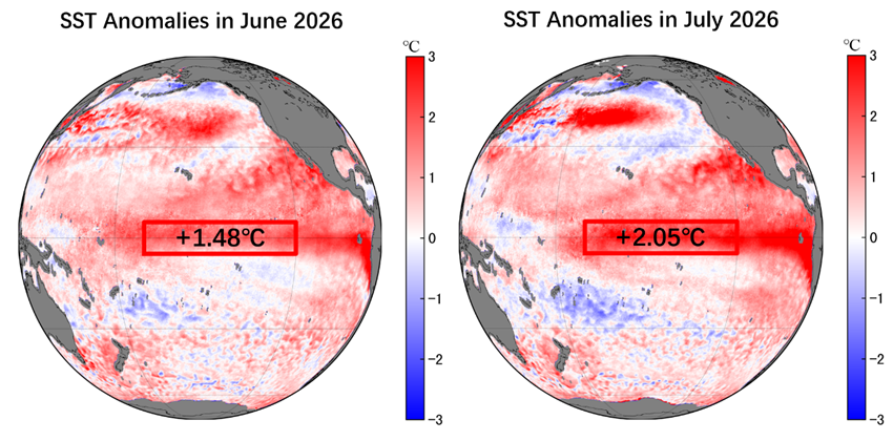
Fig. 1. FY-3 Microwave SST Anomalies for June-July 2026
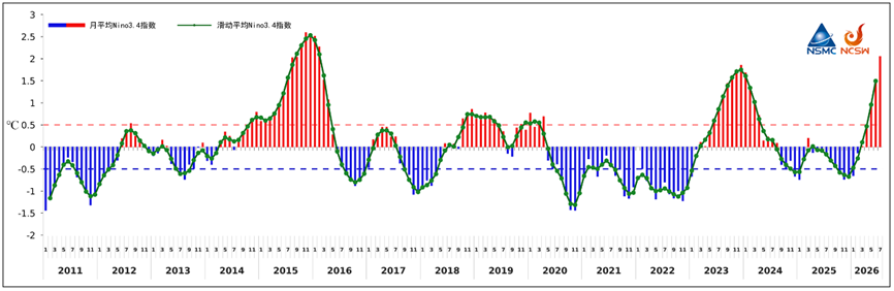
Fig. 2. Time series of the Nino 3.4 Index derived from FY satellite monthly SST anomalies with a 3-month running mean.
https://www.wmc-bj.net

Author: Xie Jin, Zheng Zhao Jun Reviewer: Zhou NingFang
English reviewer: Wang Yi Issue approver: Dai Kan