

National Comprehensive Natural Disaster Risk Survey and Shanghai Meteorological Risk Census Empowering "One-Stop City Governance" and Safeguards Shanghai’s Urban Safety
The National Comprehensive Natural Disaster Risk Survey represents the first major national conditions and strength survey conducted since the founding of the People's Republic of China. The initiative was organized and implemented between 2020 and 2022. The State Council established the National Comprehensive Natural Disaster Risk Survey Leading Group as the highest decision-making body, with the Ministry of Emergency Management taking the lead in execution. The effort was advanced collaboratively acorss 17 national ministries, commissions, and relevant departments, including the National Development and Reform Commission, Ministry of Industry and Information Technology, Ministry of Natural Resources, Ministry of Ecology and Environment, Ministry of Housing and Urban-Rural Development, Ministry of Transport, Ministry of Water Resources, Ministry of Agriculture and Rural Affairs, National Bureau of Statistics, Chinese Academy of Sciences, Chinese Academy of Engineering, China Meteorological Administration, National Energy Administration, National Forestry and Grassland Administration, China Earthquake Administration, China Banking and Insurance Regulatory Commission, and the Joint Staff Department of the Central Military Commission.
China is one of the countries that are most severely affected by natural disasters, characterized by a wide variety of disaster types, broad geographical distribution, high frequency of occurrence, and heavy losses. The core objectives for this comprehensive risk survey were: first, to fully identify the baseline of national natural disaster risks; second, to systematically assess the disaster resilience capacity of key regions; and third, to provide authoritative risk information and a scientific basis for decision-making to support governments at all levels in carrying out disaster prevention and mitigation work and ensuring sustainable socio-economic development.
I. Meteorological Disaster Comprehensive Risk Survey: Building a Full-Chain Data System
Within the overall survey framework, the China Meteorological Administration is responsible for organizing and implementing the Meteorological Disaster Comprehensive Risk Survey. Focusing on 10 major categories of meteorological disasters, including typhoons, rainstorms, and droughts, the survey established a full-process data closed-loop system encompassing "Investigation – Assessment – Zoning – Application,"thereby shifting meteorological disaster risk management from empirical judgment to a data-driven approach.
(I) Comprehensive Factor Risk Investigation System
The survey systematically investigated four key dimensions: hazard-causing factors, exposure, disaster reduction capacity, and historical hazards, covering the following aspects:
Comprehensive Disaster Types: Earthquakes, geological disasters, meteorological disasters, marine disasters, forest fires, agricultural disasters, and infrastructure failures.
Meteorological Disaster Types (10 categories): Typhoon, rainstorm, drought, low temperature, high temperature, strong wind, lightning,snow disaster, and sandstorm.
Exposure Investigation (6 categories): Population, buildings, infrastructure, public service facilities, three economic sectors (agriculture, industry, services), and resources.
Disaster Reduction Capacity Investigation: Emergency rescue teams, material reserves, shelters, monitoring and early warning facilities.
History and Hidden Hazard Investigation: Retrospective analysis of major historical disaster events and identification of geological hazard points.
(II) Core Logic of Risk Assessment
Disaster risk identification is a critical prerequisite for achieving early warning. Meteorological disaster risk is determined by the combination of the following three elements:
Disaster Risk = Hazard × Exposure × Vulnerability
Based on this logic, the survey conducted the following four core assessments:

(III) Four-Tier Zoning System
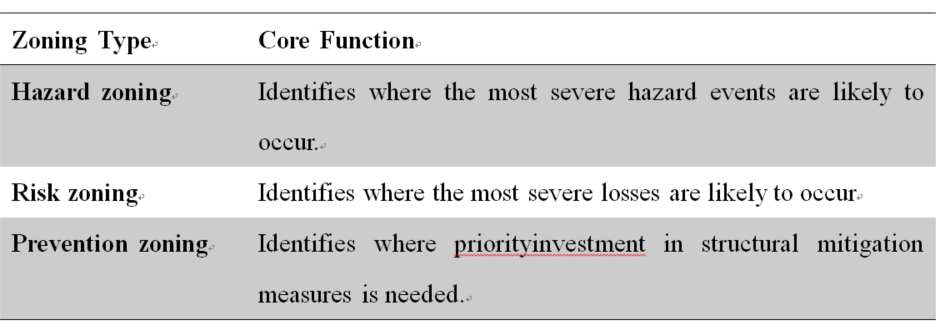
The survey established a "National – Provincial – Municipal – County" four-tier risk zoning system, translating assessment results into specific geographic areas and producing three core types of zoning maps:
(IV) Long-Term Mechanism and Knowledge System Transformation
To ensure the long-term usability of survey results, meteorological departments established the following mechanisms:
Dynamic Update Mechanism: Promoting the regular updating of survey and zoning results to build a "living data" system that adapts to urban development and climate change trends.
Sector-Specific Impact Threshold System: Moving beyond traditional general forecasting by establishing physical warning thresholds for sectors like transportation, power, and agriculture (e.g., water accumulation depth, wind speed thresholds, consecutive drought days)which enables refined early warning triggers.
Core Knowledge Outputs: Constructing the "China Natural Disaster Risk Knowledge System" to support multi-sector early warning capabilities and enable precise identification of high-risk areas and vulnerable populations.
2. Meteorological Risk Census Empowers "One-Stop City Governance" and Safeguards Shanghai’s Urban Safety
Based on district-level surveys of severe weather hazards such as typhoons, gales and rainstorms in Shanghai, historical severe weather event datasets have been established at both district and municipal levels. These datasets have been integrated into risk early warning applications for typhoons, severe convective gales and rainstorm waterlogging, providing critical support for decision-making by government authorities.
From 12 to 15 September 2022, Typhoon Muifa brought widespread heavy to torrential rain across Shanghai. Starting at 20:00 on 12 September, the Shanghai Meteorological Service conducted dynamic assessments of typhoon-induced disaster hazards based on real-time meteorological observations, numerical forecast outputs and typhoon census technologies. The assessment results were incorporated into decision support materials and submitted to the Municipal Government. For instance, at 08:00 on 13 September, by combining observations from 20:00 on 12 September to 08:00 on 13 September and 72-hour smart grid forecast products, it was estimated that Shanghai would face moderate to high typhoon-induced disaster risks from Typhoon Muifa (2212) in the subsequent 72 hours, with high-risk zones requiring special attention.


Figure 1 Track of Typhoon Muifa and assessment of typhoon-induced disaster risk at 08:00 on 13 September 2022
The risk assessment products were, on the one hand, integrated into decision support materials for municipal leaders. On the other hand, they were embedded in the Shanghai Risk Early Warning System to serve 25 urban operation and management departments, with nearly 200,000 daily accesses during the typhoon. The municipal government and relevant departments promptly initiated flood and typhoon emergency responses based on the forecasts issued by the Shanghai Meteorological Service.
Thanks to the concerted efforts of all departments, Muifa, the strongest typhoon (by sustained winds) to make direct landfall in Shanghai since 1949, yet caused the fewest disaster losses with the largest evacuation. The goal of "zero fatalities, few injuries and minimal losses" was achieved.